

Fungal Stress Responses
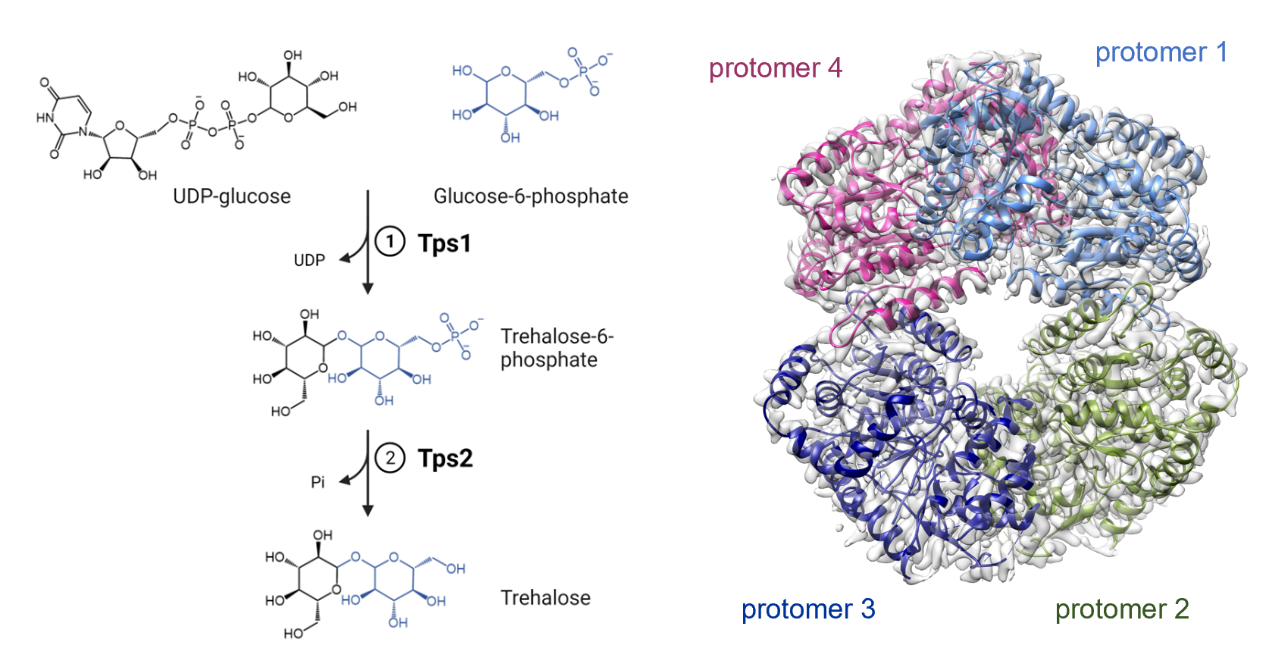
Trehalose Biosynthesis.
The Washington Laboratory studies the structure, function, and regulation of the fungal trehalose biosynthesis pathway. Our goal is to understand how this conserved stress-response system promotes fungal survival during infection and how it can be exploited for antifungal drug development.
Trehalose is a sugar composed of two glucose molecules that helps fungi withstand environmental and host-associated stresses. In pathogenic fungi, trehalose contributes to adaptation, survival, and virulence, making its biosynthetic pathway an attractive therapeutic target. Importantly, the pathway is conserved across many medically important fungal pathogens but is absent in mammals, providing an opportunity for selective antifungal intervention.
Trehalose is synthesized through a two-step enzymatic process. Trehalose-6-phosphate synthase (Tps1) converts UDP-glucose and glucose-6-phosphate into trehalose-6-phosphate (T6P), which is subsequently converted to trehalose by trehalose-6-phosphate phosphatase (Tps2). Many fungi also express Tps3, a non-catalytic regulatory protein that is thought to coordinate protein-protein interactions within the biosynthetic complex.
Our research seeks to determine how these proteins assemble, function, and respond to environmental stress. We are particularly interested in understanding how trehalose biosynthesis is activated during elevated temperature exposure and how this pathway promotes thermotolerance in major fungal pathogens. By combining genetics, biochemistry, structural biology, and chemical biology approaches, we aim to uncover fundamental mechanisms of fungal stress adaptation and identify new vulnerabilities for antifungal therapy.